UK Phone Number Format: Complete Guide for Businesses (2026)
If your business takes calls from UK customers, getting the phone number format right matters more than it seems. A wrong digit, a missing +44, or a dropped area code can mean a customer can’t reach you, or your CRM logs the number wrong.
This guide breaks down exactly how UK phone numbers are structured.
What Is the UK Phone Number Format?
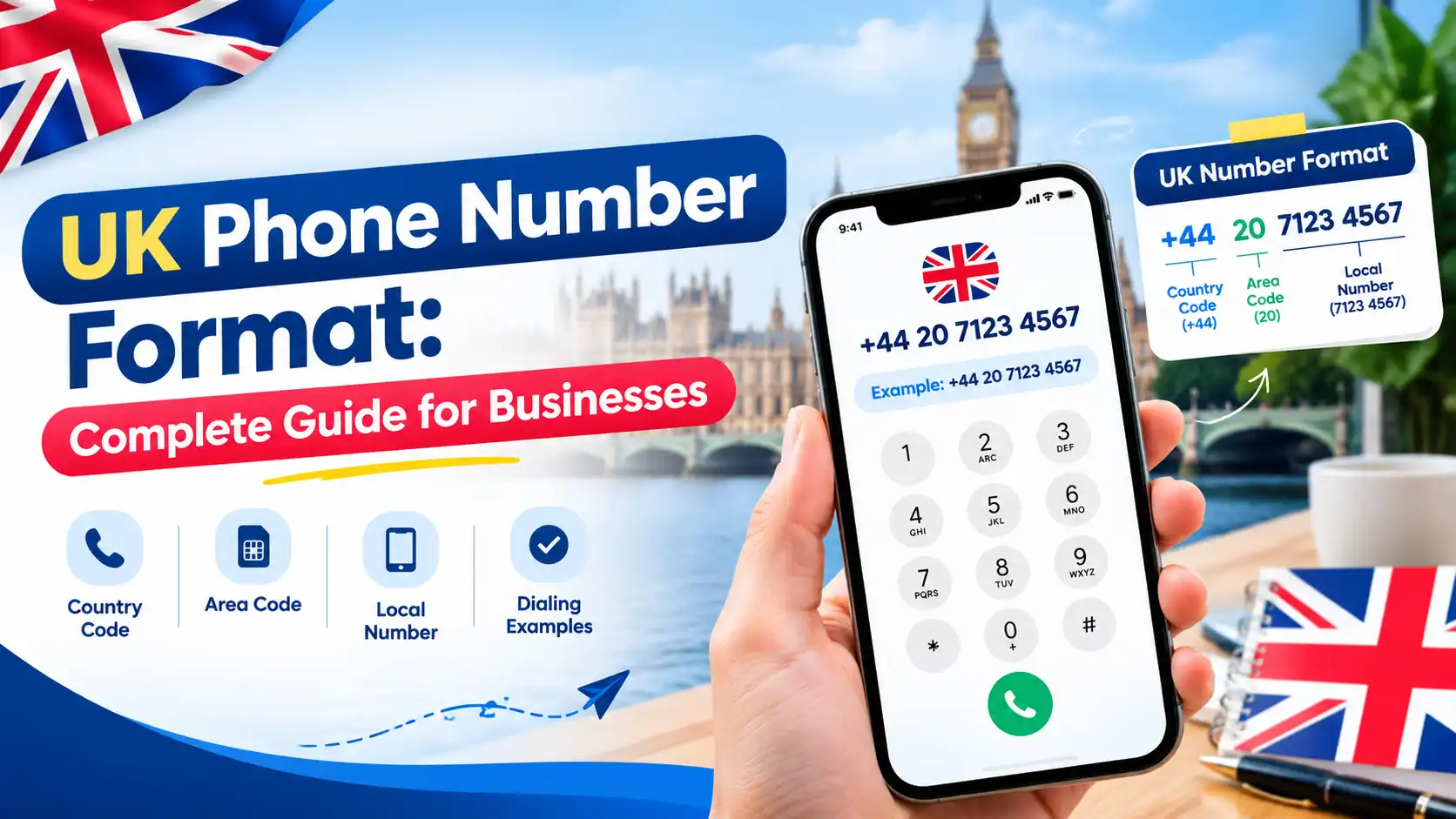
Every UK phone number starts with the country code +44. After that comes the National Destination Code (NDC), usually called the area code, and then the subscriber number.
The area code can be anywhere from two to five digits long. Bigger cities tend to have shorter area codes because they need more subscriber numbers underneath them.
London’s area code, for example, is just 020 (three digits), while some smaller towns have area codes as long as five digits.
When you add up the area code and subscriber number, most UK numbers come to 10 digits in total (not counting the leading 0 or +44). A small number of older numbers only have 9 digits, but that’s rare today.
UK numbers are written using the international E.164 standard when used outside the country. This standard keeps the format consistent (+ country code + number) so phone systems and software worldwide can read it correctly.
UK Phone Number Format Examples
Here’s how the same number looks in different contexts:
- Local format (dialled within the UK): 020 7946 0958
- International format (E.164): +44 20 7946 0958
Notice that the leading 0 is dropped once you add +44. This is one of the most common mistakes people make when entering a UK number internationally — the 0 and the +44 are never used together.
For a mobile number, the same rule applies:
- Local format: 07911 123456
- International format: +44 7911 123456
Types of UK Phone Number Format
Not all UK numbers work the same way. Here’s a breakdown of the main types your business is likely to deal with.
i. Geographic (Landline) Numbers — 01 and 02
Numbers starting with 01 or 02 are tied to a specific location. The area code tells you the region, and the subscriber number follows.
- 020 — London
- 0161 — Manchester
- 0131 — Edinburgh
Most 02-prefixed numbers have 10 digits after the leading 0.
ii. Mobile Numbers — 07
UK mobile numbers always start with 07 and have 11 digits in total when dialled locally (including the leading 0). Mobile numbers aren’t tied to any location or network — the prefix simply marks the number as a mobile, not a landline.
- Local: 07911 123456
- International: +44 7911 123456
iii. Free Phone Numbers — 0800 and 0808
These are free for the caller. Since 2015, calls to 0800 and 0808 numbers have been free from both landlines and mobiles across the UK. Businesses often use these for customer service lines where they don’t want to pass on call costs to customers.
iv. Non-Geographic Business Numbers — 03, 084, 087
- 03 numbers (030, 033, 034, 037) are charged at the same rate as a standard geographic call and are included in most call packages and inclusive minutes. Many businesses use 03 numbers because they give a national presence without the cost concerns some customers have around 084/087 numbers.
- 084 and 087 numbers can carry an extra service charge on top of the standard access charge, which is why regulation now requires businesses to display the cost clearly. Ofcom rules also mean these numbers can’t be used for customer service or after-sales calls by certain businesses.
UK vs US Phone Number Format
If your business deals with customers on both sides of the Atlantic, it helps to know how the two systems differ.
| Feature | UK Format | US Format |
| Country code | +44 | +1 |
| Domestic trunk prefix | 0 (dropped when using +44) | None |
| Area code length | 2–5 digits (varies by region) | Always 3 digits |
| Total digits (national number) | Usually 10, occasionally 9 | Always 10 (3 + 3 + 4) |
| Local dialling example | 020 7946 0958 | (212) 555-0198 |
| International dialling example | +44 20 7946 0958 | +1 212-555-0198 |
| Mobile numbers | Separate 07 prefix, not location-based | No separate prefix — mobiles use the same area codes as landlines |
| Toll-free prefixes | 0800, 0808 | 800, 888, 877, 866, 855, 844, 833 |
The biggest practical difference is area code length. In the US, every area code is exactly three digits under the North American Numbering Plan (NANP), which makes the format very predictable. In the UK, area codes vary in length, which is why UK number validation needs a bit more flexibility than US validation.
FAQs on UK Phone Number Format
Q1. What is the UK country code?
The UK country code is +44. You add it in place of the leading 0 whenever you’re dialling a UK number from outside the country, or entering it into an international field on a form.
Q2. Is +44 the same as 0?
No, but they do the same job in different contexts. The leading 0 is used when dialling within the UK. When dialling from abroad (or writing a number in international format), the 0 is removed and replaced with +44.
Q3. Are UK numbers 10 or 11 digits?
Written locally with the leading 0, most UK numbers have 11 digits in total (0 + 10-digit number). Once you drop the 0 for international format, you’re left with 10 digits after +44. A small number of older numbers have one digit fewer.
Q4. Do mobile numbers have area codes?
No. UK mobile numbers all start with 07, but this isn’t an area code — it doesn’t point to a location. It simply identifies the number as a mobile.
Q5. What’s the difference between 03 and 0800 numbers?
03 numbers are charged at the same rate as a normal geographic call and are usually included in call packages. 0800 (and 0808) numbers are completely free for the caller, on both landlines and mobiles.
Q6. How do I write a UK number for an international audience?
Drop the leading 0 and add +44 in front. For example, a London number written locally as 020 7946 0958 becomes +44 20 7946 0958 in international format.
Final Words
Getting the UK phone number format right isn’t complicated once you know the pattern: country code, area code, subscriber number, and the 0-for-+44 swap when going international.
Where it gets more important is when you’re setting up business numbers — choosing between a geographic, 03, or freephone number affects both cost and how customers perceive your business.
Whichever format you use, make sure it’s entered consistently across your website, CRM, and call routing so customers can always reach you without friction.
Read More : How to Dial a Phone Number With an Extension? (The Right Way)